The Icelandic Historical Association recently published its first English-language title: Iceland and Greenland: A Millennium of Perceptions by Sumarlidi R. Isleifsson. EuroClio Founder and Special Advisor Joke van der Leeuw-Roord received a copy from the Association’s President, Loa Steinunn Kristjánsdóttir, at a meeting in Brussels, and shares her review below.
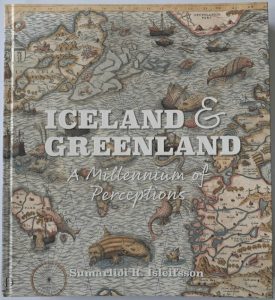
One of the largest delegations in EuroClio Annual Conferences are coming from Iceland. Nobody of the other participants would think about them as noble savages nor as wild, misbehaving others. And still, until the early the Twentieth Century, travellers to Iceland used to describe the Icelanders regularly in either way. The Icelandic academic historian Sumarlidi R. Isleifsson describes in his book Iceland and Greenland. A millennium of Perceptions, extensively how for thousand years visitors -or imagined visitors- to Iceland and Greenland describe this ultra-Nordic world.
This book is published by Historical Association of Iceland, which was established in 1902, with the aim of producing publications on the history of Iceland. This prizewinning book was originally published in 2020, and in 2025 adapted and translated into English. It is a beautiful publication, rich of written and especially high-quality visual sources, among them maps, drawings, etchings, paintings and photos. The book consists of 4 parts, the first period is from 1100-1500, the second part is about 1500-1750, the third period addressed is 1750 till 1900 and the last covers the Twentieth Century.
Many of early descriptions of the region, rarely written by travellers, but written by authors, who used their imagination, or quoting others, even of those who claimed to have visited this region describe them countries as the gate to the hell. These are wild, uninviting countries, poor, cold, full with dangers such as rocks, vulcanic mountains, geysers, snow and ice. This picture of both countries is amazingly sustainable, and is repeated, also in real travelogues until far into the 19th century. In later times some authors change this traditional narrative, and describe the region as wonderful and exiting, and try convince other people to visit the region.
In the 19th century traveling, especially to Iceland, became popular and even part of the women emancipation battle field. In many of the traditional, and of course, male descriptions, the hardships about travel to the ultra-North are emphasized. A traveller to Iceland had to fight with unapproachable nature, in order to be able to experience its wild beauty and visit Mount Hekla. It is a masculine world. But around 1850 the first female traveller, an Austrian lady, weakened their stories, by showing that visiting Iceland was also possible for women. A male traveller from the UK comes than to word, downplaying her achievements, claiming that Iceland is not so wild, not so rocky and that Mount Hekla was not very high. He gave evidence of his imperialistic attitude, boasting that he had already seen much higher mountains, and seen much wilder countries.
Recently Iceland and especially Greenland became, through the geopolitical interests of Donald Trump, in the centre of international attention. But this was certainly not the first time that outsiders wanted to gain influence or conquer these countries. In early times the Norse people from Scandinavia settled on both Islands, and a bit later the Inui from North America came to Greenland. Around 1265 both Islands became part of the Kingdom of Norway, from 1400 Norway shared power with other Nordic powers, and in 1814 Danmark became the sole overlord. Iceland gained only in 1944 independence, while Greenland is still Danish. To extend its influence the catholic church did send missionaries to both Islands from the 11th century onwards to convert its population, and established rather short-lived bishop’s sieges. The reports of such missionaries became the earliest foreign sources. The Moravian Brethren are active and even settle from the 17th century, and therefore provide more accurate reports. In the same time the area became hugely popular for fishing and especially wailing, and some authors claimed all sorts of other natural wealth, that by the way still had to be discovered. Both countries gained special strategic positions during World War II, when Denmark was occupied, and England and later the USA occupied both Islands.
The first authors describe people, who live in Greenland and Iceland in their imagined otherness. They use mythical images, quite often as not human, as dwarfs or even as half human, half animal. Later the explorers describe them as poor uneducated farmers or as noble savages. In the 19th century there are romantic descriptions of simple, industrious, good Christian, people, not spoiled by the vices of civilisation. When during the 19th century Icelanders and Inuit populations yield more and more to modernisation, these romantic explorers become disillusioned. In the same period nevertheless, even sometimes the same romantic authors, write very negative reports about the local population, writing about filth, boorish behaviour, excessive use of alcohol. There was in general surprisingly little personal contact, the visitors look at local people from a racial perspective, describe them but hardly make real contact. The 18th and 19th century authors show the same colonial attitudes as elsewhere in the world during that period, their writings mirror with borealism Saids orientalism.
This publication is a rich source, about foreigners’ visualisation of both Islands. For the not informed reader it is not always easy to grasp what they are writing about, due to a lack of contextual information. Only in the last part, the period after 1900, such information is present. Similar explanations are missing in the earlier parts of the book.
This attractive book is aiming at the international market. A small historical introduction at the beginning of each of the four chapters, would not only give a must needed historical knowledge, but also would have increased a wider readers’ understanding, how outsider observations without local dialogue can lead to serious and sometimes even hilarious misconceptions and misinterpretations. However, this book is absolutely beautiful. The Icelandic Historical Association has done a wonderful job. I can only hope that they now consider to publish a similar high quality English language publication about the histories of Iceland and Greenland. Considering the growing geopolitical importance of the region, such publication would be more than welcome.
The publication can be ordered via the website of the Icelandic Historical Association https://sogufelag.is/product/iceland-and-greenland-a-millennium-of-perceptions/
[/fusion_text][/fusion_builder_column][/fusion_builder_row][/fusion_builder_container]