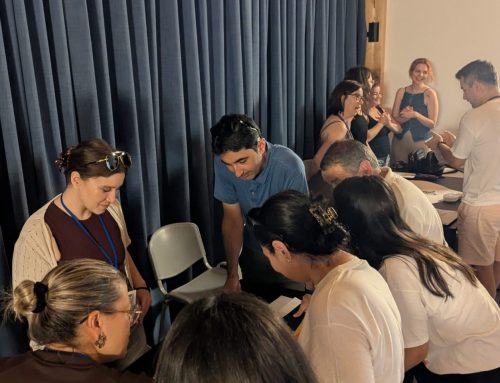
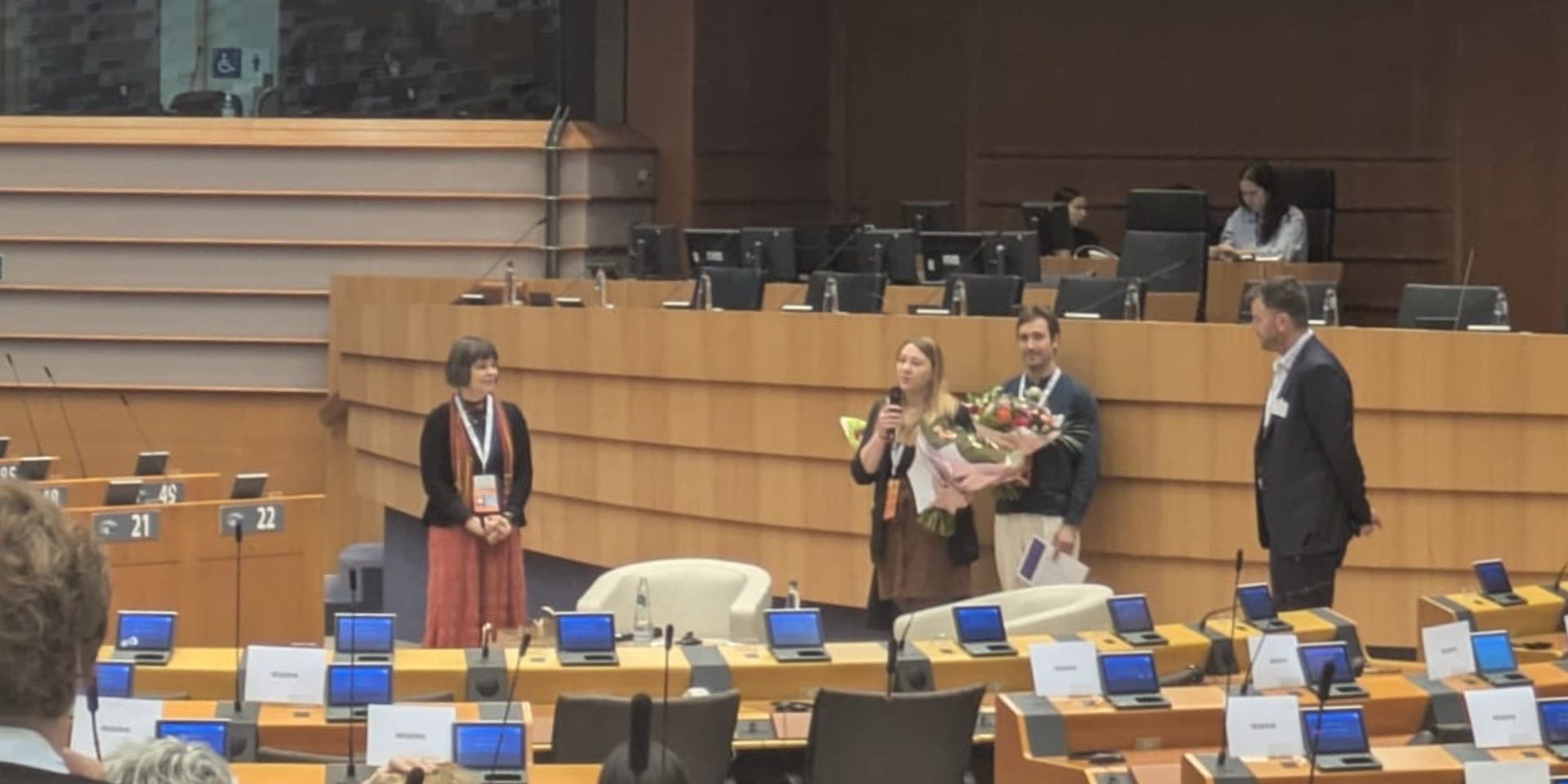
On 29 April 2026, during the EuroClio Annual Conference History and Hope at the Hemicycle of the European Parliament in Brussels, the inaugural History Education Dissertation Prize was awarded to Dr. Marjolein Wilke (KU Leuven).
The prize – an initiative of EuroClio in collaboration with the International Society for History Didactics (ISHD), the Centre for Historical Culture at Erasmus University Rotterdam, HEIRNET, and IRAHSSE – aims to bridge the gap between academic research and classroom practice by recognising doctoral work with genuine practical value for history teachers. A jury of history education scholars representing the participating organisations shortlisted three finalists; the winner was then determined by a vote of history teachers and educators attending the conference.
Winner: Dr. Marjolein Wilke (KU Leuven, Belgium), Historical thinking in upper secondary education. Examination of teachers’ beliefs, effective instructional practices and potential civic effects
Wilke’s dissertation impressed both the jury and the teacher community by combining rigorous empirical analysis and direct classroom applicability. In three integrated studies – a qualitative investigation of teacher beliefs, a design-based study producing a fully developed teaching unit on decolonisation after 1945, and a large-scale randomised controlled trial – Wilke demonstrates not only what effective history education looks like, but how to build it. The teaching unit has already been downloaded by over 700 teachers and teacher-educators across Belgium and the Netherlands. A notable finding: gains in historical thinking did not automatically translate to democratic citizenship skills, which challenges a widespread assumption in the field and opens up important new questions for history educators everywhere.
Runner-up: Dr. Sara Karn (Queen’s University, Canada), Perspectives on Historical Empathy for History Education in Canada: Purposes, Problems, and Possibilities
Karn’s dissertation addresses a significant gap: historical empathy has been theorised internationally for decades yet remained largely absent from Canadian history curricula and research. Through interviews with researchers and practising teachers, she maps how empathy is conceptualised and nurtured by teachers who receive little official guidance on the topic. The jury recognised a timely and field-advancing contribution, particularly for its careful distinction between the “historical” and “personal” dimensions of affect in history learning.
Runner-up: Dr. Brent Geerts (KU Leuven, Belgium), Negotiating colonial heritage. (Co-)designing history museum education in postcolonial perspective
Geerts studies how history education can be designed around museum collections – specifically, Swahili-Arab heritage – that were originally curated for the purpose of national glorification. Working with two contrasting Belgian museums, his dissertation shows how instructors often prioritise cognitive disciplinary facts over emotional-affective engagement. Through performance tasks and a five-month professional learning community, Geerts collaborated with teachers and museum guides to study how individual positionalities shape teaching design and practice. The jury highlighted the originality of his cross-profile comparisons and his critical attention to the distinction between formal school-based and non-formal museum education.
EuroClio warmly congratulates all three finalists on their excellent and meaningful research and extends its thanks for the work that so clearly bridges the gap between academic research and the history classroom. The next History Education Dissertation Prize will be awarded in 2028.