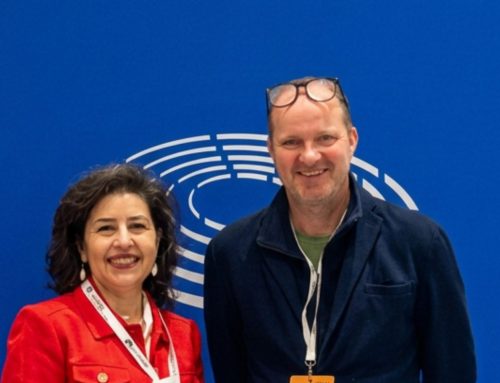
We are delighted to share that Eugenie has been appointed as EuroClio’s new Deputy Director. Having started her journey at EuroClio as a trainee, Eugenie has grown alongside the organisation and taken on a range of responsibilities and roles over the years. We spoke with her about her journey within EuroClio, what this new role means, and what she is looking forward to most.
First of all, congratulations on becoming Deputy Director! You started at EuroClio as a trainee. Can you tell us a bit about that journey?
Thank you! I am very excited and grateful for this new step! And indeed, I started as a Trainee in January 2020, just before the COVID-19 pandemic started. At the time, I had just finished my graduate studies in history, and I really wanted to explore how I could use my knowledge and skills in practice (but not in a teaching role) while also being able to see the result in a more tangible way. I did several internships throughout my academic studies, but as a Trainee at the Secretariat, it was the first time that I was really given ownership of tasks, and at times, I felt a bit thrown into the deep. The first project I worked on was In Europe Schools, in cooperation with a Dutch national broadcaster. We developed educational materials about topics like migration, climate change, and gender equality. At the time, my main role was to recruit schools from all over Europe and coordinate the partnerships between schools within the project. It was quite a demanding project, and I learned how to liaise with different stakeholders: Partners, authors and schools. Towards the end of the project, we had reached more than 300 schools across Europe. As a Trainee, it felt empowering to have contributed to the success of the project. When my Traineeship was about to end, I was offered a part-time opportunity as Project Manager to finalise the first cycle of In Europe Schools. I was lucky because this worked out well in terms of budget and timing.
Then, about half a year later, I was offered a full-time position, and for me, this really was a pivotal moment in my EuroClio career. I felt very welcome and supported by everyone at the Secretariat, and I am very grateful for that. Yet, I felt I was lacking a lot of experience and knowledge. A famous credo is: ‘’You learn on the job’’. I think you really get to experience this at EuroClio, while also being given the trust, support and safety from colleagues within and outside the Secretariat. Because of this, I also got to start my professional career in a place where ‘’mistakes’’ or ‘’mess ups’’ were not ‘’punished’’ but really seen as an opportunity for learning. I believe this environment, and the exposure to great minds within our network, has really been crucial to my journey at EuroClio.
As a Project Manager, I (co-) lead many different projects, but more relevant to my current role as Deputy Director, I also worked as Operations Coordinator in the past couple of years. In this capacity, I supported the day-to-day management of the Secretariat, including the financial management and planning. We are an international NGO with a big impact but a relatively small staff, which means that a lot of the operations are actually done by ourselves. That also includes things like ensuring that salaries are paid on time, that annual financial audits are carried out and that we are compliant with rules and regulations that are relevant to us. This part of my portfolio has really helped to better understand what it means to run an international organisation like ours, what the challenges are and also reflect on what EuroClio can look like in the future. This experience has also helped me to prepare for my new position.
Looking back, what have been some important moments in your journey from trainee to Deputy Director?
Oof, this is a very tough question. I think there have been many of these moments, and it is hard to choose. They include events, projects, and also conversations. I will probably go for the moment when I was asked to manage Who Were the Victims of the National Socialists? That was the first time I was fully in charge of leading a project from start to finish. I had just started my full-time position at the Secretariat. It was a very ambitious project in which we teamed up with teachers from five European countries to carry out local (place-based) history projects about the victims of Nazi persecution, including the organisation of a youth workshop. At the time, we had not done a project like this before, and the timeline was very tight. It was a privilege to work with so many excellent teachers and other wonderful experts. At the same time, it was a very challenging learning journey for me in several aspects. I had to lead the development of an output that we had never made before, coordinate and support the local history projects on a very complex topic, bring together a transnational team of different experts, manage donor relations, and, of course, handle the financial management and reporting. Now, this doesn’t sound out of the ordinary if you are familiar with our work, but at the time, being very young in my EuroClio career, this was a transformative experience. Luckily, I got a lot of support from the project team and, of course, also from my colleagues at the Secretariat.
It really was the first time that I got to experience what it entails to be in a position in which you are responsible for ensuring that the project runs smoothly, but more importantly, that it is also a meaningful journey for everyone involved. How do you create materials and activities on this specific topic in an ethical and responsible way? How do you ensure the quality of the work and these materials? How do you bring together people from different backgrounds and expertise? How do you build trust? What do you do when things do not go as planned? What risks can you identify and how to mitigate these? How do we make sure everything is delivered on time? What is the potential impact of the project for EuroClio in the long run? And more practically, how do we stay within budget and make sure we are compliant with all the donor requirements?
I believe a lot of these questions always come back in any of the projects and activities we do, but it is especially (soft) skills like effective communication (including active listening), collaboration, navigating a diverse group of people (and their expertise) and adaptability that I have taken away from that particular experience, and highly value and continue to work on.
What does the role of Deputy Director entail and what are you most looking forward to in this new role?
Practically, it means that there is another staff member at the Secretariat who can be the main point of contact and has knowledge of how the organisation operates when the Executive Director is away or not available. I think that would be the very short description.
More extensively, it entails working closely with the Executive Director and the Board on all sorts of questions around Governance, including the preparation of our General Assemblies, Annual Reports, and contributing to the multiannual planning of EuroClio. It also includes earlier-mentioned operational tasks that are related to the day-to-day running of the Secretariat, which I already have been doing and will continue to work on. And apart from that, I will of course also continue working on a variety of projects and exploring new collaborations.
I am mostly looking forward to learning and reflecting about how we can make EuroClio, our network and mission, more resilient, sustainable and impactful. I believe our mission becomes more and more relevant each day. It also becomes increasingly challenging to achieve. But it is all the more urgent.