History & Purpose
The School for Peace was founded in 1979 in Wahat Al-Salam ~ Neve Shalom as part of the effort of local residents of the village who choose to live together as Palestinian’s and Israeli’s and sought to promote a more humane, egalitarian and just society between the two communities. The core idea of the village is to actively choose to live together by highlighting their identities and power dynamics. The School was the first educational institution in Israel promoting change towards peace and justice.
It operates as both a school for children and as an educational centre for adult courses in various courses relating to peace, conflict resolution and facilitation. For example, in autumn 2017, the School opened a three-year training program, “Building Peace & Resilience” intended to train mental health professionals to fight incontinence and lead projects to promote peace between two peoples.
Funding
The School relies on support from the courses they run, along with humanitarian aid funds, such as the United States Agency for International Development (USAID), but does not receive funding from the Israeli government.
The School for Peace: Continuing the Dialogue Event
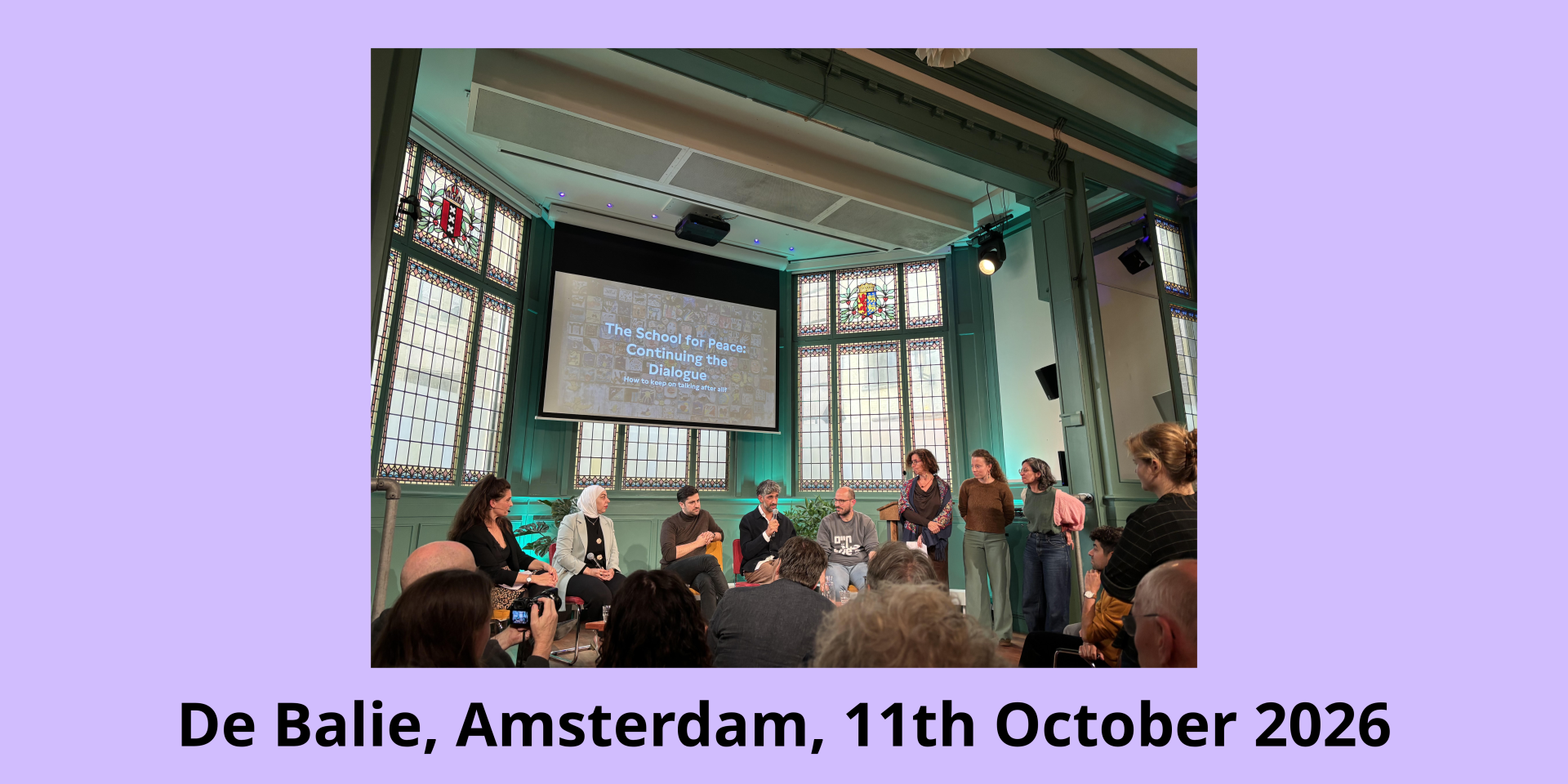
The School for Peace has recently facilitated a seminar in Amsterdam between Palestinian’s and Israeli’s living in northern Europe, bringing the two sides into dialogue. On the 11th October in De Balie in Amsterdam, an event was hosted to reflect on the impact of the three day seminar of discussion and listening. Two Young Professionals from EuroClio, Irene Catania and Alana Lavery, were in attendance to see the continuing work of the School beyond its local area in Neve Shalom~Wahat al Salam.
The event, coordinated by Veronica Baas of the de Baile and moderated by Mirthe Frese, was introduced by journalist Guus Valk who had lived in the village between 2010 and 2011 as foreign correspondent, with his daughter even attending the School. Two representatives of the School, Dr Roi Silberberg, the former Director until August 2026, and Dr Slieman Halabi, the European Project Manager, who is also a postdoctoral researcher based in Munich, were also present.
The Facilitators
We first heard from the facilitators, Slieman and Roi, on the process of bringing together Palestinians and Israelis, where national identities are very present, but an important purpose of dialogue. Instead of using a human universal language, which is not usually satisfactory to minorities, the School uses an educational methodology that highlights group identities, political differences, and power relations. After all, national identities have great power on how people discuss things and not merely as individuals.
When asked how they bring together participants, and if this is a choice?
The environment has always been quite critical of what they do but this has increased since October 7th, which made the recruitment of people more difficult. They reflected that the “word dialogue has been used and abused”. Their intention of facilitating discussion is not the sole solution, but rather a starting point, also requiring action.
The facilitators also reflected on the challenges of bringing activists into the seminar. They often have an issue with dialogue, finding it frustrating and feel they are collaborating with an injustice, perpetuating the system they are protesting. But importantly for the facilitators, they are “not trying to flatten the power structures” but believe they have to “work with people to make social change”.
They also reflected on October 7th 2023, the aftermath of Hamas’ attack, and the ensuing war on Gaza, which made people more suspicious of neighbours, and less interested in dialogue. Yet conversely, those who seek dialogue, are requesting it with urgency because of a “doom-day feeling”. Ever since the attack, peace has become a more problematic term and even considered changing the name to the School for Justice, but decided that peace is not only a catchy word but represents their core aim, while far off, it is part of the hope that sustains the mission of the School.
The Panel Discussion
The event continued with a panel, with participants from the seminar, Shahira Fakher, Tom Givon, Alaa Arda and Itay Garmy, two from Israeli contexts and two from Palestinian. Most had worked within activist networks for Gaza support or the Israelis for peace network.
The discussion was deeply personal of each of the participants’ journey to being involved in activism, their own personal contexts and feelings of loneliness while experiencing the conflict from Europe.
An important part of the process of dialogue is space to speak, and space to listen, to hear the “other” perspective.
Final Thoughts
It was fascinating to see the work of the School beyond the village, and how it has managed to extend its method for dialogue through intimate gatherings of participants within Europe. It not only highlights how impactful the conflict is being felt globally, but also the intense sentiments of participants, not only in their identities, but also the common feeling of loneliness. Importantly, the School facilitators attempt to bring these common feelings to find common ground and to find mutual understanding.
In the case here, most participants had already willingly participated in activism within their own local communities showing their openness to dialogue. But most impactfully are the conversations beyond the seminar and the room in De Balie. The seminars are intended to have a domino effect within the participants’ own networks, to teach them how to speak out in effective ways in their everyday contexts where change can start; turning dialogue into action.
For those of us observing it has a similar effect and has also been used in Northern Ireland and Cyprus.
Written by Alana Lavery and Irene Catania