
Teaching Migration: Exploring Histories of Migration in and Beyond the Classroom
On Friday the 25th September, the EuroClio team and network traveled to the Wereldmuseum in Rotterdam for a day centred on Teaching Migration. Here we will reflect on the success of the day, the speakers and workshop hosts who helped facilitate the day and a summary of some key takeaways for those who were not able to attend.
Our Deputy Director, Eugenie Khatschatrian, and Trainee, Clara Ferreira, and those from the Wereldmuseum, Marleen Rozenbrand and Jente Diepstratenwere, were key to the behind the scenes organisation and smooth running of the day, along with a huge note of thanks to each of our speakers; Gijsbert Oonk, Jens Lenders, Iwona Guść, and Elise Storck.
Keynote Lecture from Gijsbert Oonk: Innovation, Inclusion and Practice
The day began with a keynote lecture by Professor Gijsbert Oonk of Erasmus University Rotterdam. Gijsbert is currently working within the school of History, Culture and Communication at the University and has been teaching migration for over 25-years. He observed that in the post-9/11 generation, migration has become a problem, but its rates have been one of continuity, with around 3.5% people migrating, he observed that the changes are more to do with the increase in population and the direction of migration.
Some key observations were:
- The Knowledge Gap
- Migration explains the past and the present
- Migration is never neutral
- Cities are the evidence, not the exception
- Finding a language for difference and similarity
- Migration is already in the classroom
How does migration shape national identity and how does national identity shape migration?
He turned to Football teams as a case study to exemplify the omnipresence of migration and used the example of Mesut Özil, a German football player of Turkish descent. Gijsbert finished with an important question on belonging:
The important question is no longer simply who moved, but who gets to belong and who gets to decide?
Plenary Workshop by Jens Lenders: Curating migration
 Jens is a teacher trainer and lecturer in didactics of history at Fontys University of Applied Sciences. He is a member of EuroClio’s Historiana Teaching and Learning Team, contributing to teacher training materials on heritage and history education. Jens took us through an activity created for the Global Migration project with Bob Stradling, Curating an exhibition, an activity designed to put the agency of curation in the hands of the students.
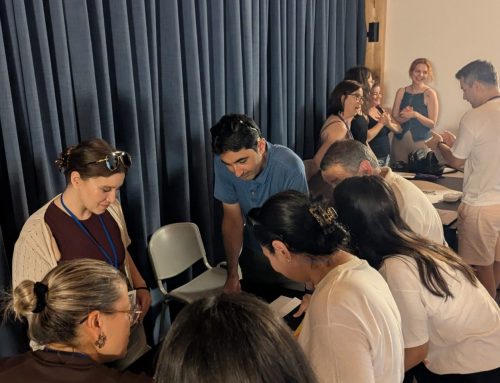
We were put into groups of two, given a wide selection of sources relating to the topic of migration and given an A3 sheet where we could decide which sources to include, and why. The activity is an innovative and adaptable activity for many different topics, but was particularly interesting to compare what story each group chose to tell.
Note: This activity is also being adapted into a Teachers Guide for the EuroClio site which will be released in the coming month.
Parallel Workshops
No.1: Sharing Authority: Teaching Migration through Oral History, Iwona Guść, Erasmus University Rotterdam
 Iwona Guść is a lecturer and researcher at the History department at Erasmus University Rotterdam. Her research focuses on migration, memory and legacies of the Cold War. In her teaching, she works extensively with oral history and project-based learning, using personal narratives to explore diversity and also ethical questions involved in studying and representing migrant history.
In her workshop, Iwona guided us through an activity she frequently uses in her classroom. She sees engagement with personal stories as a powerful and empathetic way to approach stories of migration, and her workshop highlighted several strategies she uses to do this. In Iwona’s class, students become collectors of oral history. As an example, she showed us a documentary her students created about the history and memory of the Pauluskerk for the people of Rotterdam. She emphasized the use of open and closed questions, and the importance of creating a comfortable, respectful, and safe environment, which is a priority when interviewing people about personal experiences and emotional topics. She also described how she gives students agency in the learning process: they identify their own strengths within the group and divide their roles accordingly. The students’ documentaries investigate lived experiences, using the description of sensory moments as a gateway to understanding the emotional experience behind them. Her workshop allowed us to act out this task, by taking the position as the interviewer, the interviewed, and the observer of this particular moment, captured by oral history.
No. 2: Introducing Young Track Seekers, Elise Storck
 Elise is a Teaching Methodologist for History at Leiden University’s ICLON. She was involved in the Spoorzoekersproject (TrackSeekers Project), a four-year collaboration in which history teachers from across the Netherlands jointly developed teaching materials on oral history and migration for use in secondary schools nationwide.
She adapted this project for the symposium to display the purpose behind the project. Elise explained that there was an issue with textbooks giving limited attention to migration, this led to using oral history to hear migrant stories in families. The students often did the interviews in pairs, but it could be done individually. They would be given preparation lessons on how to perform interviews and the nature of open and closed questions. It led to students gathering photos as part of the process, and then students could then present their work as an exhibition, with some posting their interviews on Sound Cloud. Some schools even collaborated with repositories to archive the work enabling students to participate in the documentation of history.
After these engaging workshops the Wereldmuseum Rotterdam invited the group to visit their permanent exhibition, their temporary exhibition on surrealist art, or join them on a stepping-scooter tour through the surrounding neighbourhood of the city.