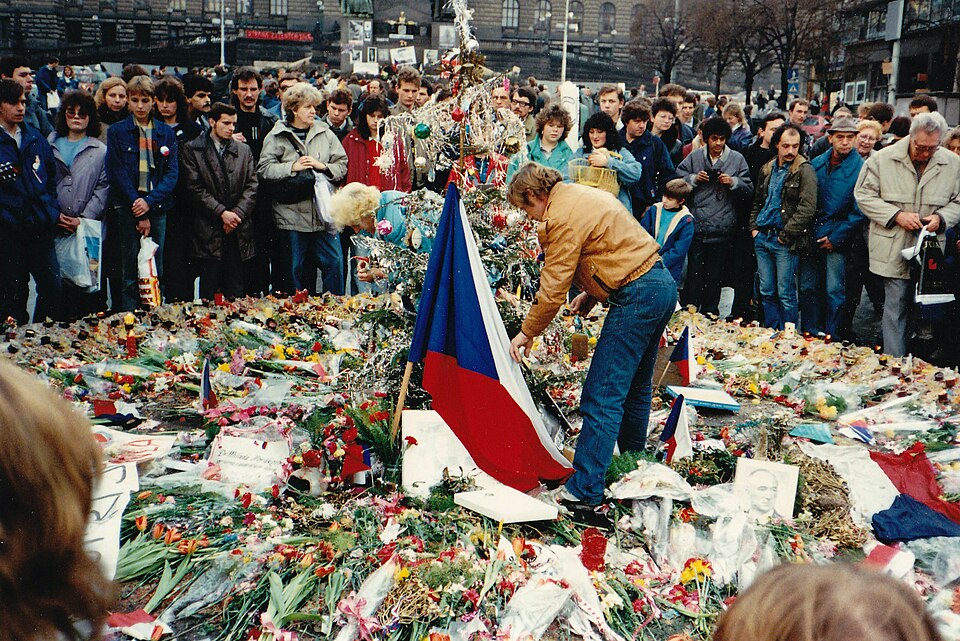
Image: Prague memorial during 1989 Velvet Revolution (Wikimedia Commons, CC 3.0)
On 16 November, Mike’s Badhuis Theatre in Amsterdam hosted a powerful commemoration of the Velvet Revolution in Czechoslovakia – an event that resonated far beyond remembrance. Organised by activists from Slovak Café Amsterdam together with volunteers from CEDIN, Danee van den Heuvel and Georgi Pavlov, who also work on the Making Visegrad History Digital project developed in cooperation with EuroClio.
The timing of the event made it particularly significant. In Slovakia, 17 November – traditionally a public holiday commemorating the Velvet Revolution – has recently been downgraded to a working day by the government. While the official justification focused on economic efficiency and the reduction of public holidays, many have questioned why this date was chosen. In the context of an increasingly Russian-leaning political direction, the decision carries a troubling symbolic weight. The importance of 17 November cannot be overstated. It marked the collapse of State Socialism in Czechoslovakia and the beginning of a new era for millions of people. Alongside other pivotal moments that dismantled totalitarian regimes across Europe, the Velvet Revolution reshaped our shared future. It deserves to be remembered and celebrated – not quietly erased or diminished. These freedoms did not emerge on their own. They exist because, in 1989, brave individuals stood up and demanded something better.
The evening opened with an evocative art performance by Celestina Minichova, centred around keychains – a powerful symbol of the 1989 protests. The ringing of keys once echoed through squares and streets, signalling the end of an oppressive regime. As the sound filled the theatre, it was easy to imagine thousands of people shaking their keys, witnessing cracks forming in a system that had controlled their lives for decades, and glimpsing light and hope breaking through. This was followed by a screening of the documentary Chvilky naděje (Moments of Hope), which tells the story of the movement Million Moments for Democracy through the experiences of its founders, Mikuláš Minář and Benjamin Roll. The film illustrated how defending democracy is not a one-time achievement, but a daily effort. It drew clear parallels between the events of 1989 and today’s political challenges, highlighting how populists and demagogues attempt to undermine democratic institutions, and how persistence and civic engagement remain powerful tools of resistance.
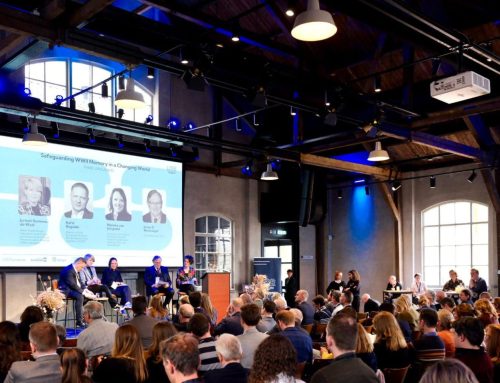
The culmination of the event was a panel discussion featuring a participant in the 1989 protests, a university professor, and the director of the film. Together, they offered insights grounded in lived experience, academic reflection, and contemporary activism. Their discussion bridged generations, showing how historical memory, education, and cultural production can reinforce one another in times of political uncertainty. Beyond the formal programme, the atmosphere of the evening was enriched by traditional Slovak food and a compelling collection of photographs, artwork, and visual materials related to the Velvet Revolution. These elements strengthened the sense of community, solidarity, and shared responsibility that defined the event.
Danee van den Heuvel and Georgi Pavlov presented the Making Visegrad History Digital project. They highlighted the importance of teaching about State Socialism in the Visegrad region through modern, digital methods—especially in today’s political climate, where historical narratives are increasingly contested or distorted. To conclude, they invited participants to take part in a short quiz on the Velvet Revolution, as well as on Slovak and Czech history. The interactive format reinforced the project’s core idea: history must be accessible, engaging, and relevant if it is to be understood and defended. Overall the event was a clear success. It sold out quickly, leaving many interested people unable to attend – yet this only strengthened the organisers’ motivation to continue with similar initiatives in the future.
The strong presence of students and young people demonstrated once again that Europeans share deeply interconnected histories and values. We should stand together not only in times of prosperity, but also in times of uncertainty and turmoil. The ideals on which the European Union is built – democracy, freedom, and solidarity – were defended by the people who filled public squares in 1989. By remembering their courage, we can find the strength and inspiration to protect those values whenever they are threatened again. Remembering the Velvet Revolution is also a reminder that democracy is never a finished project. It requires continuous care, critical thinking, and active protection if we want a better tomorrow. This message was reflected in the diversity of the audience. The event was attended not only by people from Slovakia and Czechia, but by participants from across Europe. This was no coincidence. Many of us live, study, and work in countries other than those we were born in. Events like this remind us that such opportunities were hard-won and made possible by those who resisted tyranny and demanded democracy, the rule of law, and fundamental freedoms.
Written by Georgi Pavlov, Project Officer, Centre for Education and Innovations (CEDIN, Slovakia)