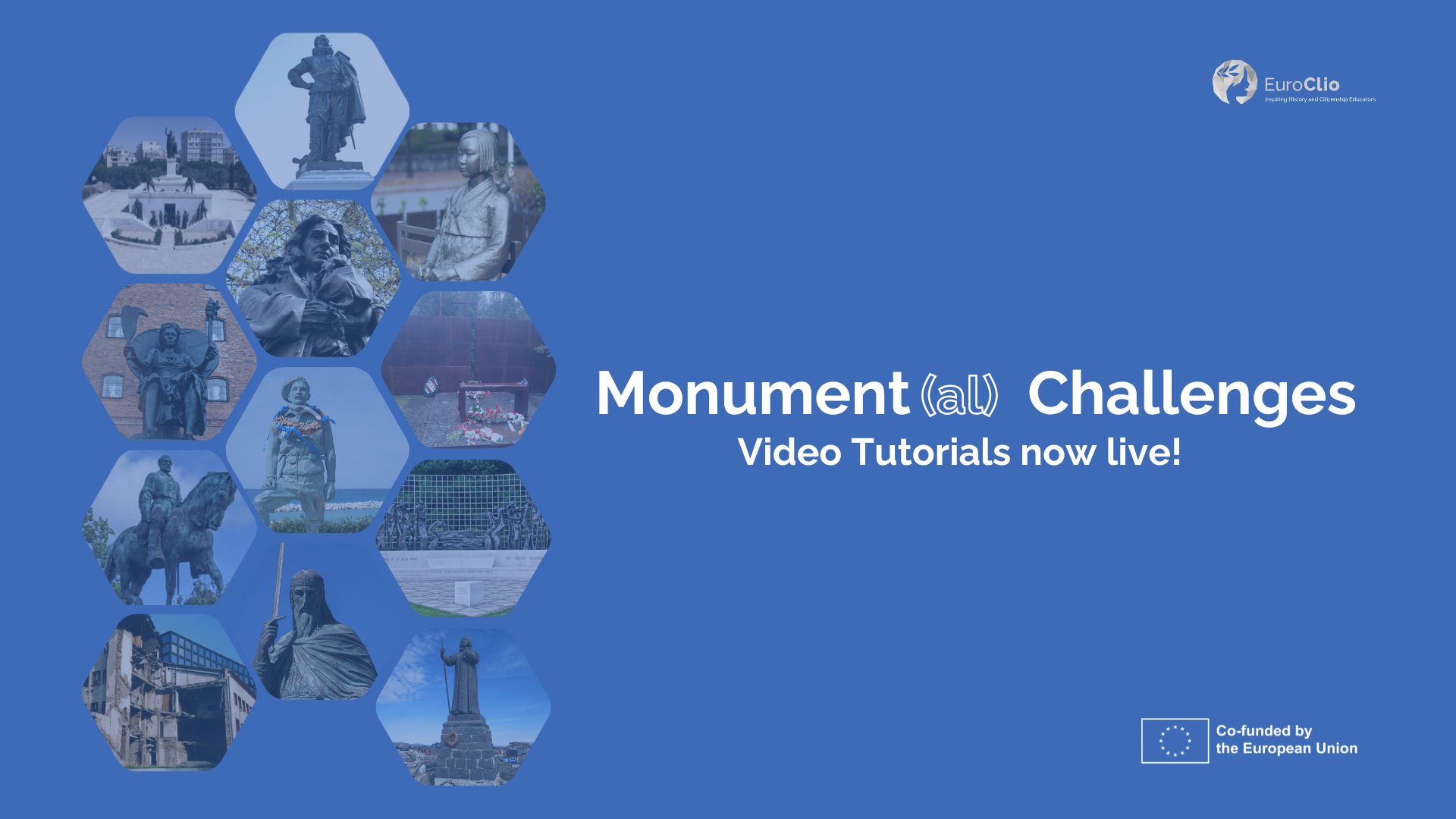
This article introduces the Monument(al) Challenges video tutorials, a series of educational resources developed as part of the Monument(al) Challenges project. These tutorials are designed to support educators in navigating sensitive, complex, and contested histories in the classroom. Developed collaboratively and reviewed by members of the Monument(al) Challenges Consortium, the video tutorials respond to the evolving challenges faced by history teachers across Europe, particularly when engaging with contested cultural heritage, public memory, and historical trauma.
The tutorials build on three lessons from the Monument(al) Challenges toolkit, each centred on a contested monument or site. Together, the videos provide educators with practical tools, pedagogical strategies, and historical thinking concepts for teaching difficult pasts. Each tutorial combines expert explanations from lesson authors with animations, archival material, historical imagery, and footage of the featured sites.
Video Tutorial 1 – How to Teach About Sexualised Violence in the Classroom?
In this video tutorial, Dr Paula O’Donohoe, author of the “comfort” women lesson plan, explores how educators can address histories of sexualised violence during conflict sensitively and responsibly. The tutorial centres on the Statue of Peace in Seoul, unveiled in 2011 and located in front of the Japanese Embassy. The statue commemorates the victims known as “comfort women”, a euphemistic term referring to women and girls who were trafficked and forced into sexual slavery by the Japanese Imperial Armed Forces during the Asia-Pacific War.
The tutorial offers concrete classroom strategies, such as:
– Avoiding graphic or distressing materials
– Allowing students to step out of the classroom if needed
– Emphasising historical and socio-political contexts rather than explicit details
Watch the tutorial here: https://www.youtube.com/watch?v=OnB9ralEbt0.
Video Tutorial 2 – How Do Values Change Over Time?
This tutorial, led by Dr Paula O’Donohoe, explores the historical thinking concepts of change and continuity through the contested legacy of Jan Pieterszoon Coen. The statue of Coen, inaugurated in the 19th century in Hoorn, the Netherlands, has been controversial since its announcement. The tutorial helps educators examine how Coen’s reputation has shifted over time and why his commemoration remains contested today. It provides tools for discussing:
– How historical figures are valued differently across periods
– Why monuments can become focal points of public debate
– How continuity and change coexist in historical interpretation
It also introduces emotional networking, a methodology developed by Hester Dibbits at Reinwardt Academie, which enables students to map emotions and their intensity in relation to the statue and the debates surrounding it.
Watch the tutorial here: https://www.youtube.com/watch?v=hSLBklim83w.
Video Tutorial 3 – How Can We Teach Multiperspectivity with Monuments?
In this video tutorial, Lidija Zupanic Suica, author of the lesson plan on the Radio Television Serbia (RTS) building, demonstrates how contested monuments can be used to teach multiperspectivity. Today, the site includes three distinct memorials:
– A privately initiated monument titled *“Why?”* listing the victims’ names
– A cenotaph with 16 trees commemorating those killed, including two whose bodies were never recovered
– The ruins of the RTS building itself, left unchanged for over 25 years and awaiting transformation into an official memorial
The tutorial examines how different actors, such as the state, victims’ families, and international organisations, shape memory and commemoration. Through a role-play exercise, students are invited to adopt these perspectives, fostering a deeper understanding of conflicting narratives and historical responsibility.
Watch the tutorial here: https://www.youtube.com/watch?v=aKnUwsUZC2E.