The Armenian diaspora is so big that it exceeds the current population living in the country today. Armenian migration patterns over the past two centuries have shaped the Armenian diaspora through forced displacements, killings, annexations, and political reforms. The Hamidian massacres in the late nineteenth century are the starting point of major displacements of the Armenian people, laying the foundation for escape routes across different locations. Armenian migration is going to be explored within this context by looking at different major events such as the Hamidian massacres, the Armenian genocide, the fall of the Soviet Union, and the Nagorno-Karabakh wars that influenced the movement of Armenians throughout the nineteenth and twentieth centuries. In the long term, Armenians who settled in places where safety was granted post-massacres and post-genocide shaped the diaspora that exists today.
Pre-Genocide Displacements: The Hamidian Massacres (1894 – 1897)
Armenian merchants had lived on different continents for centuries, mainly settling in parts of Asia and Europe across the Persian, Roman, Byzantine, and, more recently, the Ottoman and Russian Empires. During this inter-imperial period, Armenians lived in Eastern Anatolia, which quickly became a dangerous region for them to live. The Hamidian massacres, named after the reigning Ottoman Sultan Abdülhamid II, were the first mass killings of the Armenian people by the Ottoman Empire. Towards the end of the nineteenth century, the Armenians in Eastern Anatolia were seen as a threat to their religion, nationalism, and economic influence through their merchant network. Due to a rise in Turkish nationalism, problems within the empire were blamed on minorities with different ethnicities or religions. Armenians were especially targeted in political abuse for their influence on the economy in urban centers. Discrimination made Armenians vulnerable within Ottoman society, which resulted in political awareness among the Armenians. Attempts to create political parties and economic reforms yielded more distrust and hatred towards the Armenian people. This further heightened tensions during the last quarter of the nineteenth century, when the Turks were losing power over the Balkans due to similar wishes of autonomy and rises in nationalism within Europe. The Congress of Berlin in 1878 finalised this loss as Ottoman territories became part of the Balkan region, giving further reason to suspect minorities within the empire who had similar wishes of independence. Looking for protection from a government that despises them, Armenians volunteered to be a part of the Russian Empire, a rising threat to the Ottomans. This further heightened hostilities towards Armenians, fueling the perception of disloyalty and justifying the brutal killings.
Religion and the rise of the Armenian Question
Apostolicism, the Armenian stream of Christianity, was a crucial part of the Armenian identity in the nineteenth century. Although many Armenians kept autonomy over their religion and communal identity, the fear of Armenian nationalism increased in the Ottoman Empire. The fear of Armenians’ rising nationalism through religion resulted in the implementation of pan-Islamism, as too much freedom of self-expression could mean the loss of more territories for the Ottoman Empire.
The Ottoman Empire used religion as a census of its demographics; this meant that the number of Armenians in the Ottoman Empire was counted as Armenian Christians. This was further specified within the different Christian streams, mainly Armenian Christianity, which is Apostolicism, but also Catholic, Orthodox, or Protestant. The number of Armenians in the Ottoman Empire is disputed and contested, as there are no official sources of that time from any party for the number of Armenians before and/or after the massacres. Different parties with different ulterior motives could have tampered with the numbers to create a statement regarding Armenian lives lost, either by diminishing the Armenian presence in the region or by highlighting Turkey’s crimes against the Armenian people. The massacres led to the loss of an estimated 100.000 to 300.000 Armenian lives by the Ottoman Empire.
Religion, next to nationalist ambitions and potential alliance with the Russian Empire, became the reason to attack the Armenian people. The massacres, as a preface to the Armenian genocide, were meant to wipe out the Armenian “non-believing” people from the Ottoman Empire, to ensure no nationalist political movements occurred. Some men, but mostly women, converted to Islam to avoid the massacres and became a part of the Turkish community. Armenian women especially had to change their names and marry a Turkish man. Many of these converted Armenians stayed Muslim well after the massacres, feeling shame to return to their old communities. Because there were no distinctions made for the Armenians during the Hamidian massacres, the refugees who did survive and/or did not convert to Islam were of differing ages and genders. Mothers, fathers, children, all with no possessions as they fled, were desperately in need of shelter and safety.
These Armenians fled to countries that offered support, aid, sympathy, or were known to be accepting of Christians. For many, this was in countries nearby, like in Persia and the Levant, where there were already established Armenian communities living in safety as Christians. Others fled to Western Europe for safety, namely Germany and France, as they showed support for Armenians, weakening the relations between the Western European countries and the Ottoman Empire. In addition, America’s newly established Red Cross recognised the humanitarian aid that Armenians needed after the massacres. The killings were an important point on the agenda of American President Grover Cleveland, as the “Armenian question” first became a topic within America during his presidency. In the United Kingdom, the Armenian question was stalled by endless discussions and apprehension towards punishment of Sultan Abdülhamid. Despite the continuous wishes from the general public for the protection of the Armenians, the three Powers (Britain, Russia and France) could not think of a solution to the problem, allowing the Ottoman Empire to continue the massacres.
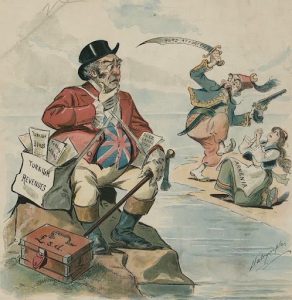
Image 2: “John Bull’s dilemma”: “It’s hard to have to disturb him–he’s such a good customer!” Puck, 1895
Who did not migrate?
To understand “who” migrated, it is interesting to note those who did not migrate, which equally speaks to the Armenian diaspora question of how people identify with the community. Apart from the communities who successfully escaped and thus sought refuge in other countries, there were many who stayed and resisted in place, rather than moving. A common strategy was for Armenian families in a town to collectively buy protection from Kurdish soldiers, so they would not be targeted by the Turkish government. This was the case in the town of Egin in Eastern Turkey, where there were 6,000 Armenians, equaling the number of Christians and Muslims in the town. Many Armenians who did not flee were promised false protection, which led to their killings. In Ourfa, 1895, Armenians were promised protection from threatening attacks if they surrendered their weapons. However, this false promise led to more lives lost, as more soldiers were dispatched in response to the Armenians asking the government for their protection. What can be understood from this strategy is that while there were many who sought refuge by migrating, there were many Armenians staying in place as a way to resist the government, which is among many explanations as to why there are so many Armenians or those with Armenian heritage in Eastern Turkey today.
These instances tell us that there is nuance to migration during massacres and that the choice of staying or fleeing was non-existent in many cases. Government tactics and false promises did not give many Armenians the grace to choose their destiny, having this choice taken from them along with their lives in an instant.
Was it really “migration”?
The term “migration” used in the story of Armenians during the Hamidian massacres can be questioned, as there was no voluntary decision made. The forced marches and fleeing following the massacres are, without a doubt, events that led to the mass displacement of the Armenian people in Eastern Anatolia, who would not have moved under other circumstances. The term “forced displacement” seems to be the most fitting in this case, as the UNCHCR defines forced displacement as: “a result of persecution, conflict of generalised violence or human rights violations”. For this context, the use of the term “migration” is used lightly, as it does not encompass the context in which these Armenians fled for safety.
Armenian migrants, or more accurately, refugees, fled Eastern Anatolia from these massacres and laid the foundation for the future genocide survivors and even the Armenian diaspora today. The Armenian genocide in 1915 was the culmination of the political and systematic policies that aimed to make Armenians as weak in society as possible.
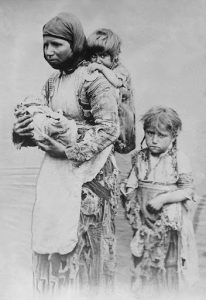
Image 3: “Armenian woman and her children from Geghi, 1899”
Violence and Forced Displacement: The Armenian Genocide (1915–1916)
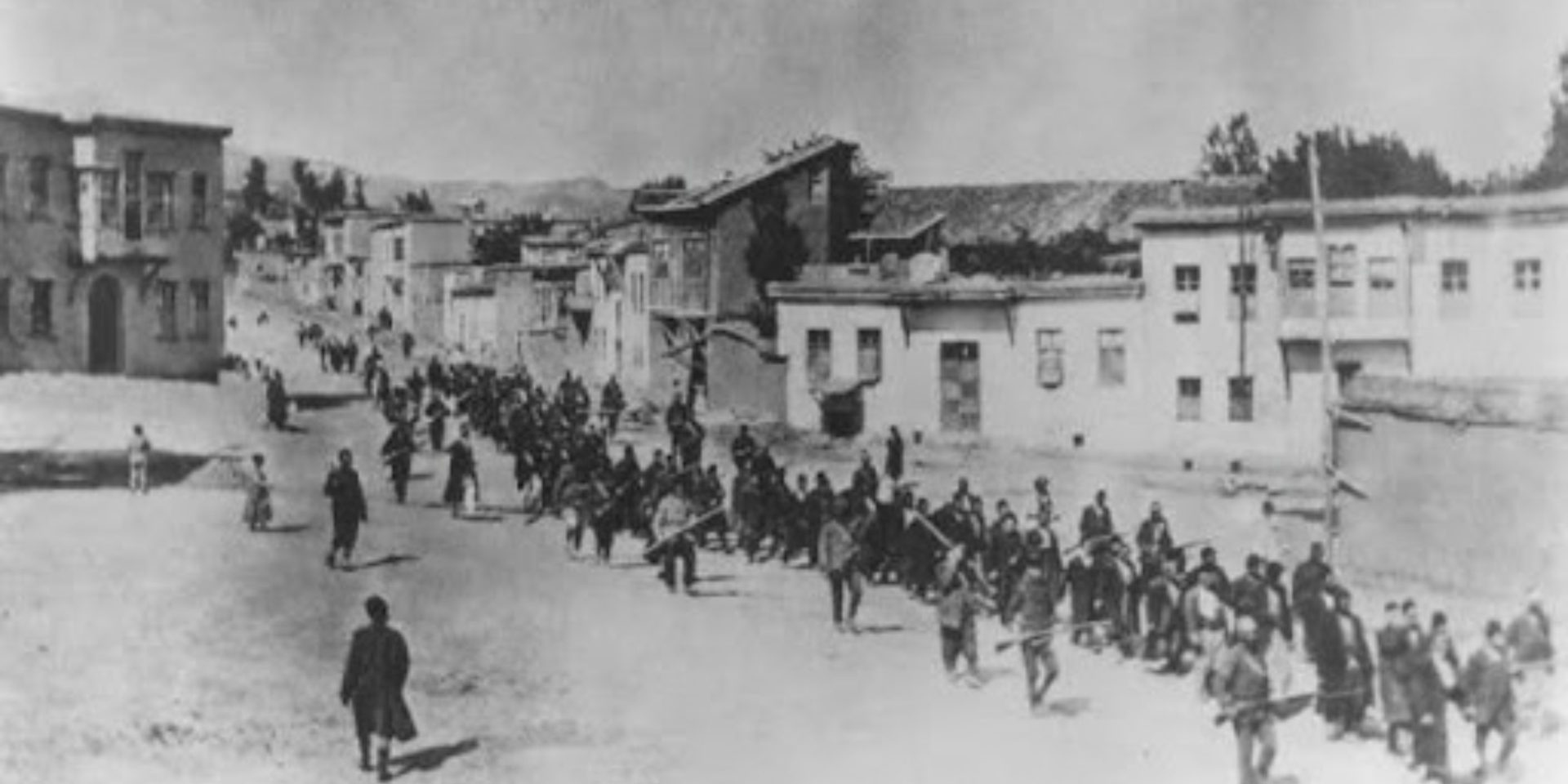
Ottoman-Armenian political and cultural leadership were the first group targeted during the 1915-16 Genocide for their supposed alliance with the Tsarist Russia and betrayal to the Ottoman Empire. On 24 April 1915, hundreds of Armenian intellectuals, politicians, and religious figures were arrested and executed. In the immediate aftermath, the Young Turk government ordered the massacres and forced deportations into the Syrian Desert, which resulted in the deaths of an estimated 1.5 million Ottoman Armenians. The only survivors left in Anatolia were a small number of women and children, who had evaded the massacres and death marches. They were subsequently Islamized and absorbed into Turkish and Kurdish households in the newly founded Turkish Republic.
Hundreds of thousands of survivors moved eastward toward the South Caucasus—which later became Soviet Armenia—or settled in various countries spanning from Syria and Lebanon to Egypt, France, and the United States. This mass displacement laid the foundation of the modern Armenian diaspora, where generations of survivors established communities across multiple continents. Today, the largest Armenian communities outside of Armenia reside in Russia and the United States, which can be directly traced back to the genocide and the earlier waves of displacement during the Hamidian Massacres. During the genocide, the famous survivor, Aurora Mardiganian, managed to flee the Ottoman Empire, first towards Tsarist Russia then to the US. Becoming a cause célèbre in the US, she spread her harrowing story to the world, bringing the “Armenian Question” to light in the West. Like Mardiganian, tens of thousands of survivors settled in the Levant near the sites of the atrocities, or traveled north into Russia with the ultimate goal of reaching the US. Together, the survivors of both the Hamidian massacres and the 1915 genocide established the global Armenian diaspora as we know it today.
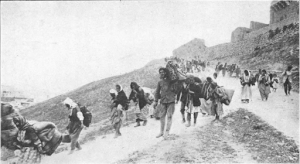
Image 4: “Ravished Armenia: The Story of Aurora Mardiganian, the Christian Girl, Who Lived through the Great Massacres”
Armenia under Soviet influence
Following the Armenian genocide, Armenia as a country experienced independence in 1918 from the Russian Empire. However, this was short lived, as Armenia joined the Soviet Union under the Transcaucasian Soviet Federated Socialist Republic (TFSSR) in 1922 together with Georgia and Azerbaijan. For the next 69 years, Armenia remained under Soviet control, and eventually became known as the Armenian Soviet Socialist Republic.
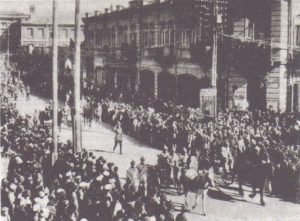
Image 5: “Red Army Invasion in Yerevan, 1920”
The start of Caucasus geopolitical issues in the Soviet Union (1922 – 1991)
The three nations, Armenia, Azerbaijan, and Georgia, were considered part of the USSR by the Moscow government, which incorporated the three respective countries into the TFSSR. With this development, Moscow ignored the ethnic and religious differences among the Caucasus people, considering the measures to be “uniting”. The Soviet administration only exerted influence out of self-interest of the union. Russians were afraid of Pan-Turkism moving towards the Caucasus, which was previously an area within the Russian Empire. With this fear, the adoption of the Transcaucasian states was purely out of this self-interest, yet disguised as bringing peace to the region. After becoming responsible for the smaller republics of the Union, Stalin decided to ignore the Transcaucasian ethnic differences and therefore their territorial disputes. This ignorance has arguably aided in many of Transcaucasia’s contemporary geopolitical problems, namely the Nagorno-Karabakh wars between Armenia and Azerbaijan. Nagorno-Karabakh can be understood better within the context of Soviet ignorance and misunderstandings of border disputes, which heightened Armenian-Azerbaijani tensions, especially considering the way both groups identified with that territory. The way that Transcaucasia’s tensions amongst the three nations were ignored by Stalin in the 1920s served as a precursor to the region’s developments later in the twentieth century. These acts of ignorance on Moscow’s part have been noted in Soviet history as the “lesser” evil by comparison to the Russian Empire. Non-Russians’ resistance, like the Transcaucasian resistance at the end of the Russian Civil War, was seen as reactionary and avoidant of the path towards progressive development.
Many Armenians who were not allowed to return to their native homeland in Ottoman territory were looking at the Armenian quasi-state to rebuild their lives in safety. Over the course of 1921 until 1936 (before the Stalinist Purges of 1936-38), forty-two thousand genocide survivors migrated to Armenia. These people returned from nations where they had been offered protection by the host country, most notably Syria, Lebanon, Iraq, Egypt, Sudan, and Palestine. After the Second World War, Armenia experienced another wave of immigration, known as the “Great Repatriation” (nerkaght) for its large scale. Between 1946 and 1949, another ninety thousand Armenians were allowed to move to Soviet Armenia from twelve different countries. One could question why the Soviet Union allowed such mass migration from outside into the isolationist Union.
The acceptance of Armenians returning from genocide host countries to the ASSR (Armenian Soviet Socialist Republic) shows the Soviet Union’s self-interest. Firstly, the initial migration wave, only a couple of years post-genocide, was meant to strengthen the Armenian people and spread Soviet ideology. As the Soviet Union could not promise the genocide survivors their native land in Ottoman (later Turkish) territory, they could offer a safe and “free” Soviet Armenia close to their old homes. This is especially ironic considering the failed promise to Armenians to have Nagorno-Karabakh be a part of SSR Armenia, as it was also promised to SSR Azerbaijan in order to appease Turkey. As for the Great Repatriation following World War 2, the biggest motivator for this mass migration to SSR Armenia is expected to be the restoration of the population post-war. What is clear is that different motives played a role in the migration patterns of the Armenians in the post-genocide period. For the Soviet Union, more citizens meant spreading and strengthening the Soviet ideology across the Caucasus region. For Armenians, this meant finally having a safe location to live without fear for their Armenianness, though this was later complicated by the Stalinist policies of Sovietization and Russian chauvinism.
The Soviet Union and its policies have made a lasting impact on the Caucasus and its migration waves in ways that can be seen today. Ethnic hierarchy within Soviet society has further caused complications for minority groups in the region, from geopolitical issues like worsened Armenian-Azerbaijani relations to the recent Russian imperialism expressed through aggression towards Ukraine. Especially the latter phenomenon exposes the discussion in (post-) Soviet history about ongoing imperialism. Similarly, the Caucasus area faces the effects of decades of Soviet rule. The involvement of Russia in the Nagorno-Karabakh region is one of many examples where Russian imperialism and centrality within smaller republics disrupted the geopolitical order.
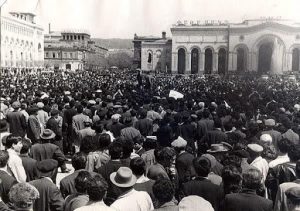
Image 6: “The first commemoration of the Armenian Genocide in Soviet Armenia, April 24 1965”
Armenian migration post-Soviet Union (1991– present)
Towards the fall of the Soviet Union, another spike in Armenian migration could be seen, one that greatly damaged the newly independent state’s ability to rebuild. Many of these migrants were Armenians living in Azerbaijan, who moved west following the ethnic exchange and displacement. This migration can be labelled as internal migration across the Armenian-Azerbaijani borders, as the Nagorno-Karabakh region was disputed within Soviet borders and were not separate nations.
One of the most notable countries that Armenians migrated to in the 1990s was unsurprisingly Russia, due to their ties to the former USSR and its lasting cultural influence of Russification. Most Armenians after the dissolution of the Soviet Union fluently spoke Russian as their second language, which was seen as a big advantage for Armenians who desired to pursue a career in Russia. In addition, due to Russia’s cultural influence on Armenia, the decision seemed easier to make and less of an unknown risk. The locations in Russia with the highest number of Armenians living there are Stavropol, Moscow, St. Petersburg, Volgograd, Krasnodar Krai, and Rostov Oblast. Apart from the big metropole cities of Moscow and St. Petersburg, most Armenians reside in the south of Russia as it is naturally closer to their home country.
Another top contender was France in Europe, due to close ties to the Armenian Christian church. The Armenian-French relations date back centuries, but the most important thing to consider was France’s support for the Armenian genocide survivors, which is how a lot of Armenians ended up migrating to France, as they received the necessary means to start a new life. Because of this, many Armenians decided to reconnect with their relatives who had lived in France for generations after the dissolution of the Soviet Union. In addition, the wish for a more capitalist and progressive country to reside in was a big motivator as well. France’s tolerant attitude towards Armenians extended to building Armenian churches in cities with a high Armenian demographic. Religious institutions in Russia, France, and America have helped strengthen Armenian communities, as religion is an important part of Armenian identity. Cities with the most populous Armenian diaspora are Marseilles, Paris, Bordeaux, and Lyon.
Finally, a large number of Armenians migrated to America. This migration pattern already existed before Armenia joined the Soviet Union, as a lot of (Western) Armenians fled to America after the Armenian genocide. In the post-Soviet period, many migrants reconnected with relatives in America or moved there because of the already existing Armenian community there. A big motivator for this group was the prospect of economic opportunities that existed in America compared to Armenia. In America, places like Los Angeles (specifically Glendale and Hollywood) and New York were interesting for Armenians to move to.
The Armenian diaspora today
The Armenian diaspora remains as one of the biggest diasporas in the world. Although only being a relatively small percentage of the total population, Armenians have an active presence in the host countries that they reside in.
Russia – In Russian society, Russian-Armenians have always had an influence, as the two countries have century-old historical ties. Armenians, wherever they go, maintain their cultural identity while also adapting to the broader, in this case, Russian society. Russian-Armenians have typically been received well in Russia, only experiencing negative encounters through generalisations for their “Caucasusness”, an identity that is ethnically different from the Slavic identity. Likely thanks to their religion, Armenians on a whole have not faced big discrimination for their Armenianness per se. They have played an important role in promoting the Armenian language and traditions among Russians they live with. Armenians also established churches in the bigger cities of the country, providing an opportunity for the community to bond. Overall, Armenians in Russia are economically, politically and academically involved. This is especially the case considering the ethnic Armenians in the government who advocate for the wellbeing of their country of origin. Armenians are among the largest ethnic minority groups living in Russia today.
France – Similarly to Russian-Armenians, the French-Armenians as a community in France have a rich history dating back to the late nineteenth and early twentieth centuries. Today, Armenians are often associated with Charles Aznavour, which is a positive association, as the late singer greatly contributed to French culture. To this day, French politics have shown a negative stance towards Turkey for many reasons, one of which is the continued denial of the Armenian genocide, which is when France experienced a great influx of Armenian migrants. In addition, the French-Armenian battalion fighting against the Ottoman Empire in 1916 was a precursor for the future positive French-Armenian relations. Today, Armenians in France have many Armenian churches and continue to maintain their Armenian heritage freely while raising awareness of the country’s continuous struggles, such as recognition of the genocide.
America – Similarly to the two countries mentioned above, the United States has been generally welcoming to the Armenian migrants. Discrimination or hostilities have never been focused on Armenians through Armenophobia, but rather as a generalisation regarding migrants in the country. Armenians have a long history with America, as many Western Armenians (Anatolian Armenians) fled to live there for better economic opportunities. In addition, many Armenians who moved to America were academics, entrepreneurs and religious figures. Armenian-Americans continue to remain a close-knit community within Glendale, which has the biggest number of Armenians living outside of their home country. Dubbed “Little Armenia”, the community continues to spread their culture, cuisine and language while also advocating for their homeland’s issues.
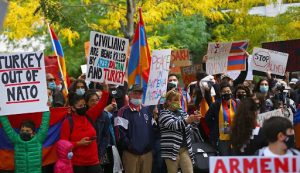
Image 7: “Local Armenian Americans protest Azerbaijan conflict, 2020”
Being a part of a diaspora is not limited to only Armenians. However, the Armenian diaspora in particular shares a unique element of bonding due to the history of its people. Armenians bond over the traumatic experiences they have faced throughout the genocide, Soviet terror, the loss of Nagorno-Karabakh, continuous border tensions with Azerbaijan and strained relations with Turkey. To this day, the Armenian genocide is not recognised by both Turkey and Azerbaijan, rubbing salt in the wounds of those who lost their lives, homes and cultural buildings. Because of this, Armenians who migrated connect with each other as they understand the deep-rooted struggle of essentially being Armenian, no matter where they are from. As Armenians continue to settle outside of Armenia, their Armenianness continues to be passed down generations, just like the first Genocide survivors a century ago. How will the Armenian diaspora continue to connect down the line of many generations that pass? And will Armenia one day see a sudden rise of migration back to the homeland?
Bibliography
Armenian genocide – Ottoman Empire, 1915, Ethnic Cleansing. (n.d.). In Encyclopedia Britannica. https://www.britannica.com/event/Armenian-Genocide/Genocide
Blank, Stephen. ‘The Formation of the Soviet North Caucasus 1918–24’. Central Asian Survey 12, no. 1 (1993): 13–32. https://doi.org/10.1080/02634939308400797.
Bolsajian, Monique. “The Armenian Diaspora: Migration and Its Influence on Identity and Politics.” Global Societies Journal 6, no. 1 (2018). https://escholarship.org/uc/item/51x1r30s.
Deringil, Selim. “‘The Armenian Question Is Finally Closed’: Mass Conversions of Armenians in Anatolia during the Hamidian Massacres of 1895–1897.” Comparative Studies in Society and History 51, no. 2 (2009): 344–71. https://doi.org/10.1017/s0010417509000152.
Douglas, Roy. “Britain and the Armenian Question, 1894–7.” Historical Journal (Cambridge, England) 19, no. 1 (1976): 113–33. https://doi.org/10.1017/s0018246x00018331.
Féron, Élise, and Bahar Baser. “Pathways to Conflict Transportation and Autonomisation: The Armenian Diaspora and the Conflict in Nagorno-Karabakh.” Ethnopolitics, 2023, 1–17. https://doi.org/10.1080/17449057.2023.2199601.
Geukjian, Ohannes. Ethnicity, Nationalism and Conflict in the South Caucasus: Nagorno-Karabakh and the Legacy of Soviet Nationalities Policy. London: Routledge, 2016.
Joseph, Jo. “The Truth and Facts about Armenian Massacre,” 2025. https://doi.org/10.2139/ssrn.5117025.
Mayersen, Deborah. “Armenian Resistance to the Hamidian Massacres.” Genocide Studies and Prevention 16, no. 2 (2022): 68–88. https://doi.org/10.5038/1911-9933.16.2.1812.
Rasuly-Paleczek, Gabriele. Migration and its impact on Armenia. University of Vienna, Department for Social and Cultural Anthropology. https://alumni-ksa.univie.ac.at/wp-content/uploads/ASSA-SN-2017-01_Migration-and-its-impact-on-Armenia.pdf.
Sanjian, Ara. “Armenian Immigration to the USSR from Arab Countries (1946–1949).” In Russian-Arab Worlds, 194–204. Oxford University Press: New York, 2023.
Wikipedia contributors. “Armenians in Russia.” Wikipedia, The Free Encyclopedia. https://en.wikipedia.org/w/index.php?title=Armenians_in_Russia&oldid=1358464965.
Wikipedia contributors. 2025a. “Forced Displacement.” Wikipedia, The Free Encyclopedia. https://en.wikipedia.org/w/index.php?title=Forced_displacement&oldid=1300526317.
Wikipedia contributors. 2025. 2025b. “Hamidian Massacres.” Wikipedia, The Free Encyclopedia. https://en.wikipedia.org/w/index.php?title=Hamidian_massacres&oldid=1301895137.
Images used
Image 1 (cover image): Jo Joseph, “The Truth and Facts about Armenian Massacre” (2025), https://doi.org/10.2139/ssrn.5117025.
Image 2: Wikipedia contributors, “Armenian Question,” Wikipedia, The Free Encyclopedia, May 5, 2025, https://en.wikipedia.org/w/index.php?title=Armenian_question&oldid=1288992923.
Wikipedia contributors. “Armenian Question.” Wikipedia, The Free Encyclopedia, May 5, 2025. https://en.wikipedia.org/w/index.php?title=Armenian_question&oldid=1288992923.
Image 3: ———. “Bestand:Armenian Woman and Her Children from Geghi, 1899.Jpg.” Wikipedia, The Free Encyclopedia, n.d. https://nl.wikipedia.org/wiki/Bestand:Armenian_woman_and_her_children_from_Geghi,_1899.jpg.
Image 4: Aurora Mardiganian, Ravished Armenia: The Story of Aurora Mardiganian, the Christian Girl, Who Lived through the Great Massacres, ed. H. L. Gates (New York, NY: Kingfield Press, 1918). Mardiganian, Aurora. Ravished Armenia: The Story of Aurora Mardiganian, the Christian Girl, Who Lived through the Great Massacres. Edited by H. L. Gates. New York, NY: Kingfield Press, 1918.
Image 5: ———. “Soviet Invasion of Armenia.” Wikipedia, The Free Encyclopedia, October 5, 2025. https://en.wikipedia.org/w/index.php?title=Soviet_invasion_of_Armenia&oldid=1315291721.
Image 6: Armenianprelacy.org, accessed November 12, 2025, https://armenianprelacy.org/2020/04/23/the-first-commemoration-of-the-genocide-in-soviet-armenia-april-24-1965/.
Image 7: Adam Sennott and Gal Tziperman Lotan, “‘America Has to Do Something’: Local Armenian Americans Protest Azerbaijan Conflict,” Boston Globe, October 11, 2020, https://www.bostonglobe.com/2020/10/11/metro/local-armenian-americans-protest-turkish-conflict/. Sennott, Adam, and Gal Tziperman Lotan. “‘America Has to Do Something’: Local Armenian Americans Protest Azerbaijan Conflict.” Boston Globe. October 11, 2020. https://www.bostonglobe.com/2020/10/11/metro/local-armenian-americans-protest-turkish-conflict/.
Author’s biography
Mariam Manukjan finished her master’s in Global History & International Relations at the Erasmus University in Rotterdam. Her research focuses on the Caucasus region within Soviet History and the lasting impact of Soviet governance on post-Soviet nations. With her experience as a second-generation Armenian immigrant living in the Netherlands, her research for EuroClio expands on Armenian migration patterns in history from the pre-Genocide era to modern-day Armenia.