This article was written by Richárd Fodor, researcher, high school teacher and assistant lecturer. The article was presented at the 6th World Congress of Teachers of the Korean War in Queenstown, New Zealand.
“Kim Il Sung is turning 75, big birthday, you know. We’ll send a letter of congratulations, the ambassador will hand it over, that’s all fine. But we’re still struggling with this whole question of giving him a medal. In a case like this, you’ve got to stop and think for a second, right? Normally, he’s going to be showered with awards anyway, so what matters is whether he gets one from us or not. So…what the hell do we do?”- János Kádár, Chief Secretary of the Hungarian Socialist Workers’ Party
When János Kádár posed this question during a closed meeting of the Hungarian Socialist Workers’ Party in 1987, on the eve of European Communism’s collapse, he revealed the ambivalence, pragmatism, and quiet calculation that characterized Hungary’s relationship with North Korea throughout the Cold War.
The newly established Communist regimes in Czechoslovakia, Poland, Hungary, Romania and Bulgaria quickly established diplomatic relations with North Korea in 1948, but it was the Korean War, the first proxy conflict of the Cold Wwar, which solidified their relationship. Eastern Bloc countries provided extensive support, sending medical and engineering teams.
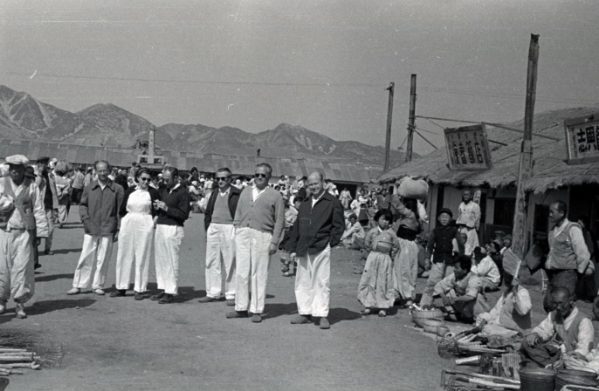
Hungary was the first Eastern Bloc country to dispatch a medical team. Between 1950 and 1957, over 200 Hungarian doctors, nurses, and medical staff served in eight successive rotations. The facility, initially named the Mátyás Rákosi Hospital, was renamed the Hungarian Hospital in Korea after the General Secretary’s fall from power in 1956. While Western European Countries such as Italy, Denmark, Norway, and Sweden supported South Korea with medical aid, Poland, Czechoslovakia, Romania, and Bulgaria provided medical equipment and personnel to their North Korean Ally.
Despite hardships of war, the Hungarian medical team established one of the best-equipped hospitals in North Korea and treated several members of the cultural elite, including poets Sol Csong Sik and Lim Hva.
From the outset, Hungarian doctors endured harsh conditions including constant bombing, air raid alerts, oppressive heat, and unfamiliar cuisine. During the UN counter-offensive, the medical team faced great danger and had to be frequently relocated. One doctor recalled in her memoirs that both bombers and fighter jets attacked them multiple times, with one strike so close she could see the pilot’s helmet. Symbolically, due to high demand and lack of donors, the staff usually donated their own blood to patients.
Eastern European support continued well after the war. Hur Jung-sook, the official overseeing international public relations, requested assistance from European communist countries for war orphans. According to the Wilson Center, the war caused some 100,000 orphans on both sides. Since North Korea was too devastated to adequately aid such an enormous number, over 30,000 children were sent to Poland, Hungary and other Eastern European countries.
Relocating children to Europe served dual purposes: ensuring better living conditions and education, and training future Korean leaders in fraternal communist countries. Among these orphans were approximately 6,000 students who left for Europe through China. Most of these students remained in their host countries between 1953 and 1959.
Poland alone welcomed over 1,000 children, the largest group housed at the State Educational Center No. 2 (Państwowy Ośrodek Wychowawczy No. 2). Situated near Krakow on a sprawling 120-acre site, the institution offered students a very isolated and secure environment.
In November 1951, the Hungarian Workers’ Party established a school in Budapest for visiting Korean orphans, naming it after Kim Il Sung. Education for Korean students was later expanded with a new institution, founded in 1953 and named after Pak Den Áj, leader of the Korean Women’s Association, which welcomed an additional 200 students.
Similar challenges emerged in both Hungary’s and Poland’s schools, including illnesses, adaptation to new cuisine, limited learning materials, language barriers, and peer conflicts. Polish and Hungarian accounts indicate that although several Korean teachers accompanied the students, access to textbooks and other materials was limited. Communication was difficult, as neither teachers nor students could speak the other’s language. In Hungary, interaction was managed through a Korean instructor who spoke Russian and a Hungarian teacher who spoke Japanese, which was compulsory in Japanese-occupied Korea.
A notable achievement of the Hungarian school was the creation of a 14,000-word Korean-Hungarian dictionary compiled by teachers and students. Still, students struggled with mastering the difficult Hungarian language, prompting communist leaders to end their segregated education and integrate them into neighboring Hungarian schools. This decision, however, led to future problems. Mózes Csoma documented a series of conflicts and abuses faced by Korean students, including bullying them by classmates. Among various factors, unsuccessful integration likely played a key role, as Korean students often remained isolated from peers whose afternoon schedules differed, even when attending the same school.
Korean students followed a strict daily schedule that started at 6AM with exercise and breakfast. Classes started precisely at 8AM and lasted until 1PM, followed by lunch, two hours of free time, homework, dinner, and a bedtime at exactly 9PM. Their only entertainment was one movie every Saturday afternoon. Observers were impressed by the student’s hard work and military-like school schedule and eventual success in learning Hungarian. One educator, the well-known Hungarian poet Ágnes Nemes-Nagy noted:
The most astonishing thing was how these boys studied. (…) with tense iron will, they fought their way forward in our difficult Finno-Ugric language (Hungarian). They worked day and night. One brilliant kid even read King Lear, in Vörösmarty’s [classical Hungarian poet] beautiful but linguistically terribly difficult translation. ‘I told you that you didn’t have to read it.’ – ‘But you also said,’ he replied in polished Hungarian, ‘that Shakespeare is a first-rate European value, and that the translation is excellent. I know two European languages: Russian and Hungarian. So, I thought I would read Shakespeare in Hungarian.
Korean students were also heavily involved in Hungary’s communist youth movement. Pioneer peace camps and inductions were organized not only to integrate them into social and recreational activities, but also to serve as instruments of political propaganda.
A series of photographs linked to such propaganda depict young Korean pioneers being visited by Kim Il Sung, who toured Europe in the summer of 1956 to seek additional economic support from his allies. Although his efforts were only partly successful, it was his longest absence from home, during which he visited several institutions to meet and encourage his future comrades.
At the request of North Korea, Hungary began admitting an unlimited number of university-level students in 1952. Approximately 300 students received scholarships, supplies, pocket money, and clothing, including a memorable blue suit. Nevertheless, these provisions proved insufficient amid Hungary’s economic hardships of the 1950’s.
The students also became subject of ideological contention. Hungarian party authorities sought to indoctrinate them on current political developments, the achievements of Hungarian communists, and the state’s designated ‘enemies and friends’. The North Korean embassy, however, firmly opposed these efforts, fearing the students could become entangled in local ideological infighting.
North Korean students also became involved in Hungary’s 1956 Revolution. Their dormitory, located at Technical University of Budapest, was an early epicenter of the unrest and later uprising. Several accounts describe Korean students fighting against the invading Soviet Army. Among the most notable figures was Zhang Gi Hong, who taught students how operate rifles stolen from a factory’s ammunition depot. Zhang Gi Hong recalled:
My roommate was one of the leaders of the events. […] The students and the revolutionaries came to the dormitory for weapons, but they didn’t know how to use them. These were drum-mag submachine guns, called tabalchong in Korean; standing in the doorway of my room, I showed them how to change the magazine safely. There were 51 or 52 rounds in each magazine.
After the Revolution was crushed, Kim Il Sung ordered the students to return to North Korea. Some were eager to leave, unsettled by the chaos and ‘fascist threat’ of the Hungarian Revolution. The Hungarian Ministry of Foreign Affairs, however, requested that they omit this from their official request for departure. Others deeply sympathized with the uprising and, upon returning to North Korea, reportedly produced leaflets and painted university walls with messages supporting the Hungarian Revolution. In these writings, students questioned the legitimacy of Hungary’s new leader, János Kádár, who had returned to power alongside Soviet forces.
Since the late 2010s, the Korean War has become one of the best-document conflicts, largely due to the work of the Korean War Legacy Foundation, which has produced comprehensive textbooks and built an extensive oral history database featuring interviews with veterans from all twenty-two participating UN nations. Alongside this, the shared history of Eastern Europe and Korea offers another perspective on this conflict. The history and narratives of European and Korean communist regimes reveal a wide range of new insights into how Cold War alliances operated beyond formal diplomacy. Humanitarian gestures such as medical missions and the hosting of war orphans and university students, were never purely altruistic; they reflected a blend of ideological solidarity, political calculation, and genuine compassion. The presence of Korean children and students in socialist Europe symbolized the reach of socialist internationalism, yet also exposed its contradictions, where ideals of fraternity often coexisted with rigid ideological conformity.
In a broader perspective, these stories reveal how Eastern Europe sought to assert its own agency within the Soviet sphere by taking part in global communist aid projects. The experiences of Hungarian doctors, Polish educators, and Korean students illuminate the subtle networks of influence, propaganda, and human connection that defined the socialist world’s engagement with Asia. Revisiting these stories offers insight, not only into the transnational dimensions of the Korean War, but also into how the “other side” of the Cold War envisioned its own version of globalism, rooted as much in loyalty and ideology as about solidarity and survival.
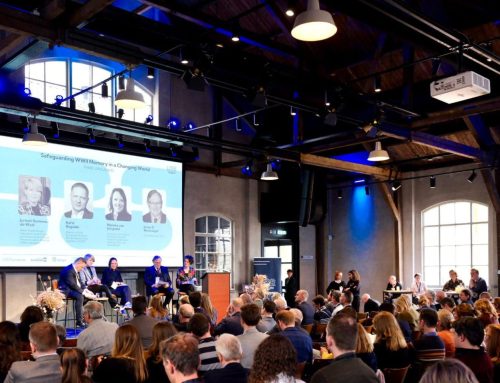
This article was presented at the 6th World Congress of Teachers of the Korean War in Queenstown, New Zealand.
The Congress was hosted by the Korean War Legacy Foundation between 9 and12 October 2025, bringing together educators from 22 United Nations member countries that contributed forces during the Korean War, alongside Korean pre-service teachers. Organised by the Korean War Legacy Foundation in partnership with the New Zealand History Teachers Association and the Ministry of Patriots and Veterans Affairs of the Republic of Korea, the congress explored the significance of the Korean War and its lasting impact on global history and democratic values. Dr Jongwoo Han, president of the Korean War Legacy Foundation, emphasised the mission of honouring veterans and strengthening international cooperation in history education. A major highlight of the congress was the launch of New Zealand’s newly developed Korean War curriculum book, designed to support educators in bringing this often-overlooked conflict into the classroom.
Participants were welcomed with a traditional Māori haka, symbolising the importance of cultural exchange and historical memory throughout the programme. The event featured keynote lectures, presentations by historians, curriculum specialists, and Korean War veterans, as well as breakout sessions addressing topics such as the role of New Zealand and Māori soldiers in the war, the war’s classification as the “Forgotten War,” and its ongoing legacy. Korean and New Zealand teacher-trainees presented their approaches to teaching the conflict, demonstrating innovative, culturally grounded pedagogies. The congress created space for historical reflection, intergenerational dialogue, and collaborative thinking about how to engage students in understanding the conflict’s global significance.
EuroClio was also formally represented, underscoring the congress’s global educational dimension. EuroClio President Ute Ackermann-Boeros and Executive Director Steven Stegers participated in proceedings, with Stegers presenting the current status and future goals of the joint EuroClio–Korean War Legacy Foundation International Baccalaureate textbook initiative. In addition, a cooperation document was signed between EuroClio and the Ministry of Patriots and Veterans Affairs by Vice Minister Kang Yun-Jin, marking an important step in expanding transnational history education partnerships. The congress ultimately served as a platform not only to honour Korean War veterans but also to advance international collaboration in promoting shared historical understanding and democratic citizenship through education.
Sources:
Csoma, M. (2014). Koreai hadiárvák és vendégdiákok Magyarországon az 1950-es években [Korean war orphans and guest students in Hungary in the 1950s]. Távol-Keleti Tanulmányok, 5(2013/1–2), 23–53. https://ojs.elte.hu/tkt/article/view/2144
Csoma, M. (2021A). Korea története: A két koreai állam történelemszemléletének összehasonlításával [History of Korea: A comparative analysis of the historical narratives of the two Korean states] (2nd ed.). Antall József Tudásközpont. ISBN 9786155559792
Csoma, M. (2021B). Rákosi Mátyás Kórház, Észak-Korea: Magyar orvoscsoportok a Koreai-félszigeten, 1950–1957[Mátyás Rákosi Hospital, North Korea: Hungarian medical units on the Korean Peninsula, 1950–1957]. Ludovika Egyetemi Kiadó.
Hańderek, M. (2025). The activities of Polish military intelligence under the cover of the Neutral Nations Supervisory Commission, and its impact on the failure of arms control in Korea, 1953–1956. Cold War History, 25(2), 245–268. https://doi.org/10.1080/14682745.2024.2436901
Hong, I. (2020, June 18). North Korea’s war orphans: Transnational education and postwar society. Wilson Center — History & Public Policy Program (blog). https://www.wilsoncenter.org/blog-post/north-koreas-war-orphans-transnational-education-and-postwar-society
Kang, H.-k. (2019, February 28). Untold stories about Korean War orphans in Europe. The Korea Times. https://www.koreatimes.co.kr/foreignaffairs/20190228/untold-stories-about-korean-war-orphans-in-europe
Levi, N., & Moon, K. (2018). Historical relations between Poland and North Korea from 1948 to 1980. International Journal of Korean Unification Studies, 27(1), 29–70. https://repo.kinu.or.kr/bitstream/2015.oak/9202/3/02_Kyungyon%20Moon.pdf
Nemes Nagy, Á. (2004). Káin, Ábel, gimnázium [Cain, Abel, High School]. In Az élők mértana (Vol. 2, pp. 169–172). Budapest: Osiris Kiadó. (as cited in Csoma, 2021A)
RETÖRKI — Rendszerváltás Történetét Kutató Intézet és Levéltár. (1987, March 10). Kim Ir Szen köszöntése 75. születésnapján [Greeting Kim Il-sung on his 75th birthday] (288. f. 5/992. ő. e., item 5). RETÖRKI Levéltár, Lakitelek, Hungary.
Riba, A., et al. (Eds.). (2023). Szó szerint: Szemelvények a Magyar Szocialista Munkáspárt Politikai Bizottsága üléseinek jegyzőkönyveiből, 1986–1989 [Literally: Excerpts from the minutes of the Political Committee meetings of the Hungarian Socialist Workers’ Party, 1986–1989]. RETÖRKI Források 6. Budapest: Rendszerváltás Történetét Kutató Intézet és Archívum (RETÖRKI).
Pictures from Fortepan Databas